
Are folding stocks legal in Virginia?

Folding_StockEvery so often I get an email or a phone call from someone who is convinced that folding stocks are illegal in Virginia.

Just to be clear … these people are wrong. Folding stocks are certainly legal in Virginia!

So why does this rumor persist?  I suspect it is because there are a few statutes which specifically do reference “folding stock” in defining certain prohibited conduct.

We will start with § 18.2-308.7 of the Code of Virginia which prohibits the possession of so-called “assault weapons” by “any person under 18 years of age.

In this code section, they define an “assault weapon” based upon a number of possible physical characteristics, one of which is “any semi-automatic centerfire rifle or pistol which expels single or multiple projectiles by action of an explosion of a combustible material and is equipped at the time of the offense with … a folding stock.”

However, this prohibition only applies to those under 18, has numerous other exceptions, and does not, as a general proposition, make folding stocks illegal.

We next turn to § 18.2-287.4 of the Code of Virginia which prohibits the carry of certain loaded firearms, by non-permit holders, in certain jurisdictions.

“It shall be unlawful for any person to carry a loaded (a) semi-automatic center-fire rifle or pistol that expels single or multiple projectiles by action of an explosion of a combustible material and is equipped at the time of the offense with a magazine that will hold more than 20 rounds of ammunition or designed by the manufacturer to accommodate a silencer or equipped with a folding stock or (b) shotgun with a magazine that will hold more than seven rounds of the longest ammunition for which it is chambered on or about his person on any public street, road, alley, sidewalk, public right-of-way, or in any public park or any other place of whatever nature that is open to the public in the Cities of Alexandria, Chesapeake, Fairfax, Falls Church, Newport News, Norfolk, Richmond, or Virginia Beach or in the Counties of Arlington, Fairfax, Henrico, Loudoun, or Prince William.”

This code section has caused a great deal of confusion over the years.  However, it is extremely limited in its scope, only applies to carry of a loaded firearm (not purchase or ownership), does not apply to permit holders, and does not, as a general proposition, make folding stocks illegal.

Finally we look at § 18.2-308.8 which prohibits ownership of “Striker 12 Streetsweepers.” It further extends this prohibition to “any semi-automatic folding stock shotgun of like kind with a spring tension drum magazine capable of holding twelve shotgun shells.

Again, you have to read all of the elements of the prohibition.  It does not generally prohibit folding stocks on shotguns but only applies to those that:

a)  Are semi-auto;

b)  Have a spring-tension magazine; and

c)  The magazine is capable of holding twelve shotgun shells.

At the risk of repeating myself, this statute only prohibits a single specific type of firearm, and does not, as a general proposition, make folding stocks illegal.

Posted in Criminal Law, Virginia Concealed Handgun Permit, Virginia Law | Comments Off on Are folding stocks legal in Virginia?

Understanding 41P / 41F

Other_ShoeThe other shoe has finally dropped …

As many have been predicting since the action date was moved to January last month, yesterday the Attorney General signed a final version of 41P (now known as 41F).

The final rule, which will go into effect 180 days after it has been published in the Federal Register, differs quite a bit from the proposed rule.  Let’s look at some of the immediate questions that need to be answered:

When will 41F take effect?

The rule is set to take effect 180 days after it is published in the Federal Register.  The American Suppressor Association is reporting that this will be ‘on or near‘ July 2nd, 2016 which implies that the final rule was published in the Federal Register yesterday (January 4, 2016).

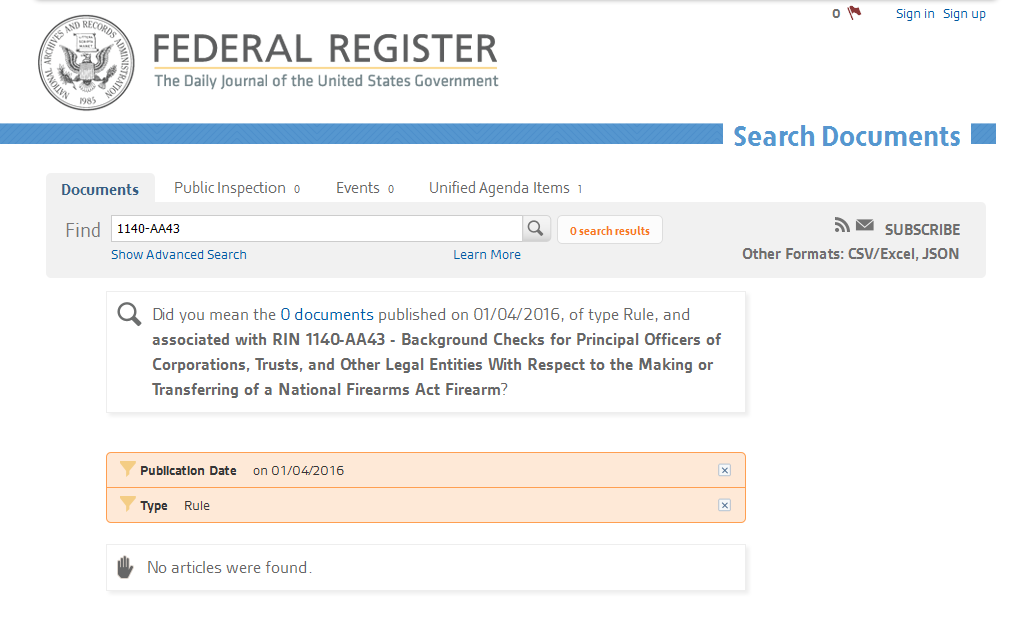
As of this morning, browsing the Federal Register for yesterday’s date fails to yield a result for 41F but interestingly enough, when you search for the Regulation Identifier Number (RIN) of the rule (1140-AA43) you get the following:

FR_41F_Search

If I didn’t know better, I would think that they are playing fast and loose with the publication requirements of the Administrative Procedure Act.  But nonetheless, we are almost certainly looking at the first week of July for 41F to take effect and you should plan accordingly.

Will it definitely take effect?

This is another popular question.  There were any number of ‘irregularities’ that various attorneys and advocacy groups pointed out when 41P was first published.  Based upon these potential violations of various federal laws governing administrative rulemaking, a number of legal challenges have been suggested.

The most prevalent of these that I am aware of is being planned by the Firearms Industry Consulting Group.  I highly recommend supporting their efforts in this regard.

However, I would advise my clients to proceed under the assumption that it WILL take effect the first week of July and plan accordingly.

Will trusts now be subject to the CLEO signoff requirement?

This was one of the areas where 41F diverges from what was proposed in 41P.  Your comments on 41P made a huge difference!

Trusts, corporations, and other non-individual applicants will now be subject to the same CLEO requirements as individual applicants … however … the requirements have been changed from requiring CLEO sign-off to only requiring CLEO notification.

What is the difference?  It means that your CLEO can be as anti-gun as they wish but they can no longer deny your Form 1 or Form 4 because they do not have to sign-off on it.  You will simply notify them (on a form to be prescribed by the ATF) and that will satisfy the requirement.  They can no longer ban you by refusing to sign.

One additional fact to note is that the notification requirement will apply not only to the grantor of the trust but to all ‘responsible persons’ of the trust.

Who do they consider a ‘responsible person’?

The rule defines a ‘responsible person’ as “those persons who have the power and authority to direct the management and policies of the trust or legal entity to receive, possess, ship, transport, deliver, transfer, or otherwise dispose of a firearm for, or on behalf of, the trust or entity.”

In the case of the trusts I provide to my clients, those would be the joint trustees listed on Schedule B.

Will trusts also be subject to the fingerprinting and photograph requirements?

Yes.  But even here there is a beneficial change between 41P and 41F (due largely I suspect to the ATF’s own staffing limitations rather than to a consideration for applicants).

When a trust applicant submits their first application after the rule takes effect, all ‘responsible persons’ will have to submit fingerprints and photographs.  However, going forward from there, if your trust has had a Form 1 or Form 4 approved within the previous 24 months and there has been no change in the trust or the list of ‘responsible persons’ then you are not required to resubmit fingerprints or photographs.

Will this affect my existing tax stamps?

No.  The rule will only apply to applications made after the rule goes into effect.  Existing tax stamps and applications that go pending before the rule goes into effect will not be impacted.

Where do we go from here?

I wanted to get an article out this morning summarizing 41F and answering the most immediate questions.  I will follow up over the next few hours and days with additional updates about such topics as:

  • Will trusts still be the preferred vehicle for NFA ownership? (Spoiler Alert … the answer is ‘Yes’)
  • What changes should I make to my trust before July?
  • What does this mean for eForms?
  • After July what will I need to do to add or remove joint trustees

If you think of other questions you would like answered, please use the contact form on the right hand side of the page to contact me.


Posted in 41F, 41P, ATF, Background Checks, BATFE, CLEO Notification, CLEO Sign-Off, eForms, Form 1, Form 4, Machine Guns, NFA Transfers, NFA Trusts, Regulatory Rulemaking, SBR, Short Barreled Rifles, Short Barreled Shotguns | Tagged | Comments Off on Understanding 41P / 41F

Does ASAP count as ‘mandatory outpatient treatment’ when applying for a Virginia CHP?

VASAPI received an email today from someone who was confused by the language on the Virginia Concealed Handgun Permit application.  For simplicity sake I will call her Terry (not her real name) throughout the rest of this article.

Terry had been convicted of misdemeanor DUI and ordered to ASAP (more accurately known as VASAP) as part of her sentence.

Having completed her sentence successfully (including ASAP) and waiting the requisite 3 years after her conviction per the requirements of § 18.2-308.09(9), she was re-applying for her CHP when she was brought up short by the wording of question 8(d) on the Virginia Concealed Handgun Permit application.

This question asks:

HAVE YOU BEEN INVOLUNTARILY ADMITTED TO A FACILITY OR ORDERED TO MANDATORY OUTPATIENT TREATMENT, OR WERE YOU THE SUBJECT OF A TEMPORARY DETENTION ORDER PURSUANT TO VA. CODE § 37.2-809 WHO LATER AGREED TO VOLUNTARY ADMISSION UNDER VA. CODE § 37.2-805?

Terry’s confusion lies in the fact that the application does not define ‘mandatory outpatient treatment’  nor does it give a statutory reference as it does for the second part of the question.  She was uncertain if the ASAP program, which is mandatory and is outpatient would qualify and did not wish to answer incorrectly.

So how do we answer this question?

Well … we start with the premise that the only dis-qualifiers for receiving a CHP are codified in the Code of Virginia.  The Virginia State Police are not allowed to add requirements of their own and § 18.2-308.02(A) of the Code of Virginia requires that the application request “only that information necessary to determine eligibility for the permit.

Given that, we have to assume that each question relates to a statutory requirement for the issuance of a CHP and since those items which disqualify an applicant are codified in § 18.2-308.09, we will start our search there.

A quick search there does not immediately reveal a relevant disqualification for ‘mandatory outpatient treatment’ but a search of all the referenced statutes shows us a single statute which does contain that term; § 18.2-308.1:3.

Going deeper down the rabbit hole, we come to the end of our analysis.  In this code section we find that § 18.2-308.1:3 only applies to mandatory outpatient treatment ordered when a person is found incompetent pursuant to § 19.2-169.2 or was ordered to mandatory outpatient treatment as part of a commitment hearing held in accordance with § 37.2-814 et seq.

Since an order to attend ASAP as part of a DUI conviction satisfied neither of these requirements, it does not count as ‘mandatory outpatient treatment’ for purposes of answering question 8(d) on the Virginia Concealed Handgun Permit application.

Posted in Criminal Law, Virginia Concealed Handgun Permit, Virginia Law, Virginia State Police | Comments Off on Does ASAP count as ‘mandatory outpatient treatment’ when applying for a Virginia CHP?

What’s going on with 41p now?

ConfusedUPDATE:  The final rule has been released

—————————————————

Since the comment period for 41p ended on December 9th, 2013, we have been waiting to see how the ATF would respond to the record breaking number of comments they received, which pointed out numerous legal flaws in their proposed regulation.

They have responded by continually kicking the can down the road in six month increments while seemingly taking no action.  Back in June of this year, I reported that the ATF had once again moved back the proposed final action date on 41p.  In keeping with the trend, they moved it forward six months to December 2015.

Now, as we close in on December, they have moved the date once again … but this time, it was only by one month.  The proposed final action date is now set for January of 2016 and the industry is abuzz with discussion over what this means.

“Did they simply move it to 2016 as a procedural matter?”

“Does the fact that they only moved it one month mean that they are almost ready to finalize the regulation?”

“Have they addressed the massive number of substantive comments they received?”

“If implemented, will the final version of the regulations have any changes which will correct the legal flaws we identified in the original?”

The answer to all of these questions is “We simply do not know.”

What we do know is this:

  1.  The ATF has publicly stated that, if implemented, the proposed regulation would not be retroactice and that transactions already pending or approved will not be affected.
  2. There are valid legal grounds to challenge the regulation should it be promulgated and a number of law firms are planning for this very eventuality.

So where does this leave us?

First, if you have been waiting to buy an NFA item, now would be a great time to get your NFA trust established and your application pending!

Second, even if 41p were to be promulgated as-written, trusts would continue to be the preferred vehicle for NFA ownership simply due to the usage and estate planning benefits.

Having said that, I personally do not believe that 41p can be promulgated in its current form and survive the inevitable legal challenges.

In summary … do not let fear of 41p stop you from using an NFA trust, with all its benefits, to build your NFA collection.

Posted in 41P, Administrative Law, AOW, ATF, BATFE, CLEO Sign-Off, Federal Law, Form 1, Form 4, Machine Guns, NFA Transfers, NFA Trusts, Regulatory Rulemaking, SBR, Short Barreled Rifles, Short Barreled Shotguns, Tax Stamp | Comments Off on What’s going on with 41p now?

Completing a Form 4 after your gun rights have been restored

Tax_StampA number of my clients who have succeeded in having their gun rights restored have since made full use of their restored rights.

They have successfully purchased one or more Title I firearmsapplied for a concealed carry permit, and are now ready to add one or more NFA items to their burgeoning collection.

Once they have an NFA trust drafted, the question that they all have is this, “How do I properly complete the Form 4 application?

Specifically, they are concerned about question 15b from the latest version of the Form 4 (14a in older versions of the form) which asks “Have you ever been convicted in any court for a felony, or any other crime, for which the judge could imprison you for [more] than one year, even if you received a shorter sentence including probation?

Yes … they left the word ‘more’ out of the question on the form.  I am sure future revisions will correct the error but the question should be read to include it.

In any case , since my clients have been convicted of a felony, their initial inclination is to answer this question ‘Yes’ … but that is not correct.  At the top of question 15, we are advised to ‘(see instruction 7b and definitions)’.

In 7b we see a detailed definition of prohibited persons which includes convicted felons. However, in the definitions section we see the following exception:

EXCEPTION: A person who has been convicted of a felony, or any other crime, for which the judge could have imprisoned the person for more than one year, or who has been convicted of a misdemeanor crime of domestic violence, is not prohibited from purchasing, receiving, or possessing a firearm if:

(1) under the law of the jurisdiction where the conviction occurred, the person has been pardoned, the conviction has been expunged or set aside, or the person has had their civil rights (the right to vote, sit on a jury, and hold public office) taken away and later restored AND

(2) the person is not prohibited by the law of the jurisdiction where the conviction occurred from receiving or possessing firearms. Persons subject to this exception should mark “no” in the applicable  box.

So … if you have had your rights successfully restored, you should answer ‘No’ to this question.

However, you should remember that, once the Form 4 has been approved, you will need to complete the same forms as if you were purchasing a Title I firearm.  The instructions for completing those forms after having your rights restored may be found here.

Disclaimer:  This information is presented for educational purposes only and does not give rise to an attorney-client relationship. Additionally, I am licensed to practice law in the Commonwealth of Virginia and this answer may not be appropriate for other states.

Posted in 4473, ATF, BATFE, Form 4, Gun Rights Restoration, NFA Transfers, NFA Trusts, Purchasing Firearms, Tax Stamp, Virginia Concealed Handgun Permit | Comments Off on Completing a Form 4 after your gun rights have been restored