 If you’ve been carrying the weight of an old charge or conviction, Virginia’s new record‑sealing law—which took effect July 1, 2026—may finally give you room to breathe again.
For many people, this law creates a real chance to move forward without a past mistake showing up every time they apply for a job, housing, or volunteer opportunity.
Some records will seal automatically behind the scenes, while others require a petition to the court, but both paths are designed to help people rebuild their lives. At the same time, the law has very specific rules about who qualifies, who doesn’t, and what needs to be checked before applying.
Understanding those details is the first step toward figuring out whether sealing is possible for you—and toward taking back control of your future. So let’s dive into the details:
1. What “Sealing” Means (Va. Code § 19.2‑392.5)
Sealing prohibits public access to criminal history records and court records held by:
- The Central Criminal Records Exchange (CCRE)
- Courts
- Police / Sheriff / Campus Police
- DMV
Two key lines from the statute:
“Sealing means to prohibit public access to records relating to an arrest, charge, or conviction…” “Any law-enforcement agency shall reply…that no record exists with respect to an arrest, charge, or conviction that has been sealed…”
Sealed records can still be shared internally between government agencies and federal agencies for legally required purposes.
2. Who the Law Applies To
- Adults arrested, charged, or convicted.
- Juveniles tried in circuit court under § 16.1‑269.1.
3. Types of Sealing Available
A. Automatic Sealing (No Petition Required)
Automatic sealing applies to:
- Acquittals, nolle prosequi, dismissals (misdemeanors)
- Certain misdemeanor convictions if the person has no other convictions and meets strict criteria
- Certain marijuana offenses (under other sections not included in this excerpt)
Automatic sealing is triggered by:
- Court clerks sending electronic notifications
- State Police updating CCRE
- Annual or monthly automated review cycles
B. Sealing by Petition (Va. Code § 19.2‑392.12 & § 19.2‑392.12:1)
Petition-based sealing applies to:
- Misdemeanors
- Class 5 or 6 felonies
- Felony larceny offenses punished under § 18.2‑95
- Certain listed misdemeanors (trespass, petty larceny, disorderly conduct, etc.)
- Ancillary matters (FTA, contempt, probation violations) if tied to the same event
Petitioners must meet all six criteria in § 19.2‑392.12(F), including:
- No serious felony history
- 7–10 years crime‑free period
- Rehabilitation if substance‑related
- Restitution paid
- No more than two prior sealing petitions granted
- Showing “manifest injustice” if the record remains public
4. Who Is Not Eligible (Ineligible Offenses List — § 19.2‑392.12(L))
This is one of the most important parts for your website visitors.
A. Entire categories of offenses are excluded, including:
- DUI (§ 18.2‑266)
- Domestic assault (§ 18.2‑57.2)
- Hate crimes (§ 52‑8.5)
- Sex offenses (Articles 7, 3, 4, 5 of Title 18.2, except narrow exceptions)
- Violent felonies under § 17.1‑805(C)
- Any offense requiring sex offender registration
- Animal cruelty (Article 9 of Title 3.2)
- Election offenses (Title 24.2)
- Dangerous/vicious dog offenses
- Offenses involving GHB or flunitrazepam
- Offenses where the victim was a family or household member
- Violations of protective orders
- Felonies involving firearm use, unless firearm rights have been restored
B. Procedural ineligibility
A person is also ineligible if:
- They already had two petitions granted in their lifetime
- The offenses arise from different transactions (petitions can only cover one event)
- They have unpaid restitution
- They have recent convictions within the 7–10 year lookback period
5. What Sealing Does Not Do
Even after sealing:
- It does not restore firearm rights
- It does not restore civil rights
- It does not erase restitution obligations
- It does not prevent use of sealed records in:
- Bail hearings
- Sentencing
- Pretrial reports
- Child custody cases
Statutory line:
“An order to seal…shall not serve to restore a person’s civil rights or a person’s right to possess…a firearm…”
6. When Applicants Must Still Disclose Sealed Records
Disclosure is still required when:
- Applying to law enforcement agencies
- Required by state or federal law
- Required for national security positions
- Allowed under rules adopted under §§ 9.1‑128 and 9.1‑134
- Serving on a jury (felony convictions only)
- In child custody proceedings
7. What Applicants Should Check Before Filing
A. Check your criminal history for:
- Conviction type (misdemeanor vs. felony)
- Offense date (must be after Jan. 1, 1986)
- Whether the offense is on the ineligible list
- Whether multiple charges arose from the same event
- Whether restitution is fully paid
- Whether you have two prior sealing petitions
- Whether you have any convictions in the last 7–10 years
- Whether the offense involved a firearm
- Whether the victim was a family/household member
B. Check your court records for:
- Case numbers
- Final disposition dates
- Arresting agency
- Whether any ancillary matters exist (FTA, contempt, probation violations)
C. Check your CCRE record for:
- State Identification Number (SID)
- Whether prior offenses were already sealed
- Whether the record shows any disqualifying convictions
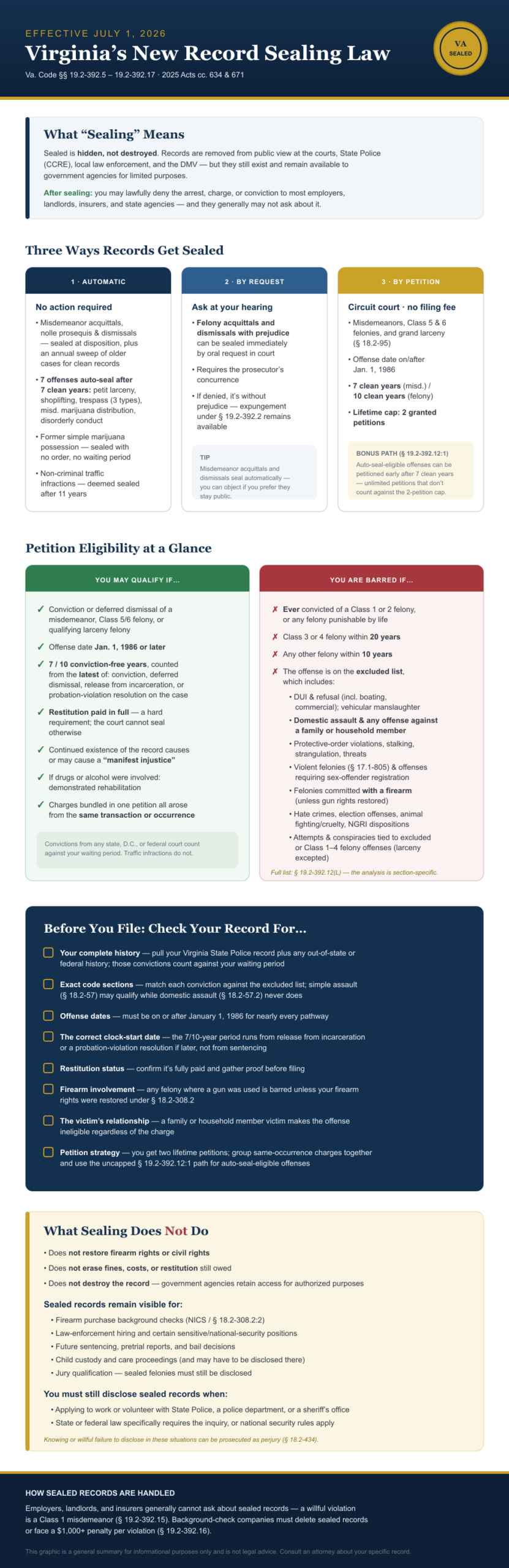
The following infographic shows the various paths in a more readable format.