
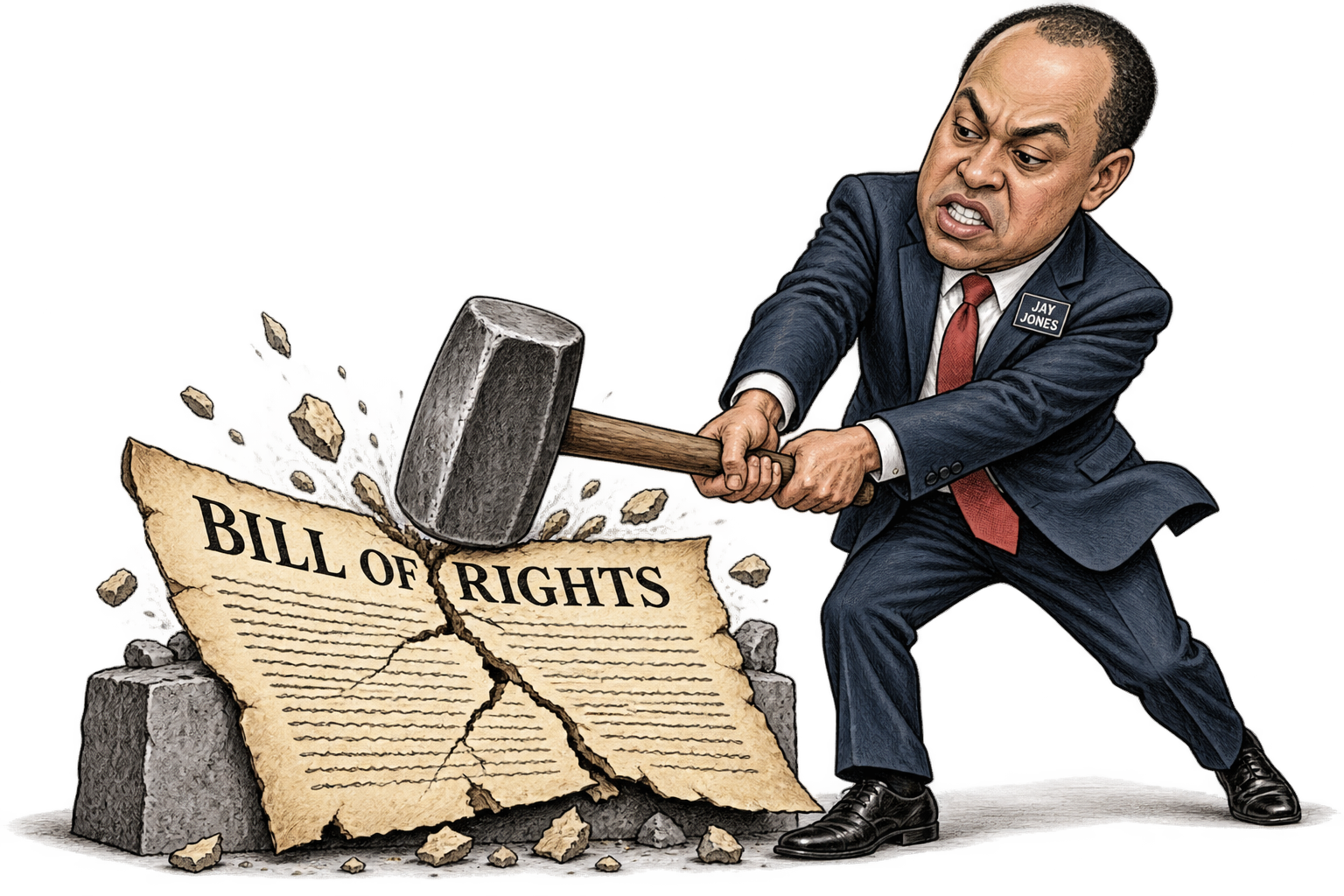
 When Virginia Democrats enacted HB 21 and its companion, SB 27, I warned that the law was not simply about punishing illegal firearm sales. Illegal sales were already illegal. The broader purpose and predictable effect of HB 21 was to place the firearms industry under a vague new civil-liability regime—one capable of making lawful dealers, manufacturers, distributors, and sellers defend their judgment after the fact under standards such as “reasonable controls” and conduct deemed “unreasonable under all the circumstances.”
The Attorney General has now supplied the enforcement machinery.
On September 15, 2026, Attorney General Jay Jones announced the creation of a dedicated Firearms Accountability & Industry Responsibility Unit, or “FAIR Unit,” within the Office of the Attorney General. According to the Attorney General’s announcement, the unit will investigate members of the firearms industry and bring civil-enforcement actions under HB 21/SB 27.
This is not merely a new title placed on an existing employee. The Attorney General’s office says it is recruiting civil litigators, prosecutors, and investigators for the unit. A state job posting says the new unit chief will design complex investigations, build affirmative cases, supervise attorneys and investigators, and oversee outside counsel. Another posting seeks a senior investigator to examine business, financial, regulatory, and transactional records and identify patterns that may support enforcement cases.
In other words, Virginia taxpayers are now funding a specialized litigation operation focused on one constitutionally protected industry. (Unit-chief posting; senior-investigator posting)
What Powers Did HB 21 Give This New Unit?
The reach of HB 21 is intentionally broad. A “firearm industry member” includes a person engaged in the sale, manufacture, distribution, importation, or marketing of a firearm-related product. “Firearm-related product” includes not only firearms, but ammunition, components, unfinished frames or receivers, and firearm accessories. Virginia Code § 59.1-148.5.
The law requires industry members to establish and implement “reasonable controls.” It also declares that unlawful or supposedly unreasonable conduct that knowingly creates, maintains, or contributes to a broadly defined public nuisance can create liability. Virginia Code § 59.1-148.6.
The available remedies are formidable. The Attorney General—or a local county, city, or town attorney—may seek:
- an injunction restricting a business’s future conduct;
- abatement of the alleged nuisance at the industry member’s expense;
- restitution;
- compensatory and punitive damages;
- attorney fees and litigation costs; and
- any other relief a court considers appropriate.
The law also creates a private cause of action for an allegedly injured person and expressly says that a plaintiff need not prove that the industry member intended to create a public nuisance or cause public harm.
Perhaps most concerning for dealers is the Attorney General’s power to issue a civil investigative demand before filing a lawsuit whenever he claims reasonable cause to believe that a person has violated, is violating, or is about to violate the law. Virginia Code § 59.1-148.8.
Through that process, the Attorney General can compel witnesses, sworn testimony, business records, and written answers to interrogatories. Virginia Code § 59.1-9.10.
That means the burden can begin long before the Commonwealth proves a violation—or even files a complaint.
Why “Responsible Dealers Have Nothing to Fear” Is Not an Answer
Attorney General Jones says the FAIR Unit is aimed at “bad actors.” Every responsible dealer supports prosecuting straw purchasers, traffickers, prohibited possessors, and businesses that knowingly violate the law. That is not the dispute.
The dispute is whether government should be able to impose crushing civil exposure through vague, hindsight-driven standards unique to the firearms industry.
HB 21 does not limit liability to a willful violation of a clearly stated firearm statute. It invites arguments over whether a dealer’s precautions were sufficiently “reasonable,” whether a marketing decision was “improper,” whether a business should have detected a risk not apparent at the time, or whether lawful conduct somehow “contributed” to a public nuisance.
The Attorney General’s own announcement identifies marketing practices and “known risks associated with particular products” as possible targets, without supplying a clear rule that lets a business know in advance where lawful commerce ends and liability begins.
That uncertainty is the point at which civil regulation becomes a burden on the exercise of constitutional rights.
The Second Amendment protects people, not businesses. But ordinary Virginians cannot practically acquire firearms, ammunition, training equipment, and accessories without a functioning lawful marketplace. Pressure the dealers, manufacturers, distributors, insurers, and payment providers, and the burden inevitably reaches the citizen.
Some businesses will limit inventory. Some will curtail advertising. Some out-of-state companies may decline to serve Virginia customers. Dealers may refuse transactions that are lawful but could later be portrayed as insufficiently cautious. Compliance and insurance costs will rise, and consumers will ultimately pay them.
Whether or not the Attorney General will admit that chilling effect as the objective, it is the obvious and predictable result.
Civil Process Can Become the Punishment
A small Virginia gun store does not possess the litigation budget of the Commonwealth. Responding to broad investigative demands, producing years of records, retaining counsel, defending depositions, hiring experts, and litigating an amorphous public-nuisance claim can threaten a business even if the Commonwealth never proves liability.
That is why the creation of a dedicated state unit matters. HB 21 was already a dangerous tool. The FAIR Unit gives the Attorney General specialized personnel whose job is to find targets, develop novel theories, and bring affirmative cases. The Commonwealth can fund that work with public money; every accused business must fund its defense out of its own pocket.
The Orwellian “FAIR” branding does not make that imbalance fair.
What About the Protection of Lawful Commerce in Arms Act?
The federal Protection of Lawful Commerce in Arms Act, commonly called PLCAA, has not disappeared. It generally prevents lawsuits seeking to hold lawful firearm businesses responsible for crimes committed by third parties. It does not immunize an industry member from liability for its own unlawful conduct.
HB 21 appears designed to exploit PLCAA’s exception for certain knowing violations of statutes applicable to firearm sales or marketing by creating a new state-law duty and then using an alleged violation of that duty as the basis for suit.
The United States Court of Appeals for the Second Circuit allowed a similar New York statute to survive a facial challenge, and on June 15, 2026, the United States Supreme Court declined to review that decision. National Shooting Sports Foundation, Inc. v. James, Supreme Court Docket No. 25-1026.
That denial of review was not a ruling that every application of such a law is valid. The Second Circuit’s decision is not binding on federal courts in Virginia, and PLCAA preemption, due process, First Amendment, dormant Commerce Clause, and other defenses may depend on the facts of a particular investigation or lawsuit. Those issues will likely become concrete when the FAIR Unit selects its first targets.
What Virginia Dealers Should Do Now
Virginia firearm businesses should treat this announcement as an enforcement warning, not political theater.
Dealers should review and document their compliance procedures, including employee training, straw-purchase warning signs, theft-prevention measures, inventory controls, transaction refusals, marketing practices, and procedures for customers who present evidence of a substantial risk of unlawful use or self-harm.
Written policies matter, but consistent implementation and documentation matter just as much. A dealer receiving a civil investigative demand, preservation request, subpoena, complaint, or informal inquiry from the Attorney General’s office should promptly preserve relevant information, notify any applicable insurer, and obtain counsel familiar with both firearms law and civil enforcement. The deadline to challenge a civil investigative demand can be short.
The Bottom Line
The Attorney General is using state personnel and taxpayer resources to build a specialized enforcement apparatus aimed at the firearms industry.
That should concern every law-abiding Virginia gun owner—not because lawful dealers should be excused from genuine wrongdoing, but because vague civil standards and ruinous litigation costs can be used to suppress lawful commerce without ever directly banning it.
HB 21 supplied the threat. The FAIR Unit shows that Democrats intends to use it.