Probably the single question I am asked most frequently by NFA trust clients is “What do I need to do when I move?”
When I mentioned this to one of my law school classmates (who does not own any NFA items) he asked why this particular issue causes so much anxiety in the NFA community?
The answer is simple … NFA collectors understand that the suppressors, short barreled rifles, short barreled shotguns, AOWs, and machine guns they own are some of the most heavily regulated consumer products in the country.
They also understand that violating any one of several dozen ATF regulations can instantly transform a law-abiding citizen into a criminal. And let’s not forget that, in addition to federal laws and regulations, many states have their own laws governing NFA items which an unsuspecting new resident may inadvertently violate.
So … with that having been said … what do you need to do when you are moving and you have properly registered NFA items?
We start with a key question … are you moving in-state or out-of-state?
I Am Moving In-State
The good news is that if you are moving in-state then there is no legal requirement that you notify the ATF of your new address. However, up until June of 2013, it was requested that NFA owners send a letter to the ATF when moving in-state so that the NFRTR (registry) could be kept up to date.
Since June of 2013, the ATF has returned such letters with a note that they are no longer accepting address changes in the form of letters and requesting that those wishing to report a new in-state address submit a Form 5320.20.
In summary … you have no legal duty to notify the ATF of an in-state change of address. If you wish to do so, you should use a Form 5320.20.
I Am Moving To A New State
If you are moving to a new state then the situation is very different. You have some homework to do before you do anything else.
First, you should know that your trust will remain valid. Any trust that is validly created under the laws of the state in which it was created will be given full faith and credit by any other state. In addition, Virginia (like many states) has adopted a version of the Uniform Trust Code.
But just because the trust will remain valid does not mean that you can automatically take your NFA collection to that state. You will want to have your trust assets reviewed by an attorney licensed to practice law in the state you are moving to who is familiar with both trust law and the NFA.
This attorney will help you determine if there are any state laws which would either prohibit or restrict the possession of one or more of your NFA items. If so, you have several options.
- Any joint trustee residing in your current state of residence may store the offending NFA items so long as they retain the status of joint trustee.
- You may store the offending NFA items in a safe deposit box in your current state of residence.
- You may store the offending NFA items at the home of a friend or relative in your current state of residence in a locked room or container to which only one of the trustees has the key or combination. If you choose this option then you should provide your friend or relative with a copy of the trust, the registration forms, and a letter from the grantor authorizing storage of the firearm at that location.
Once these issues are resolved then you need to apply for, and receive, permission from the ATF to transport your NFA items across state lines prior to the move. As mentioned earlier, you do this by submitting a Form 5320.20. Let me say that one more time … you must have an approved Form 20 before you transport any of your NFA items (excepting suppressors and AOWs) across state lines.
And while suppressors and AOWs technically do not require a Form 20 to cross state lines, I strongly recommend that, in the case of a permanent move, you submit a Form 20 for them in any case so that the NFRTR can be updated to reflect your new state of residence.
Finally … once you have your approved Form 20(s) in hand then you may move with confidence.
Disclaimer
I am only licensed to practice law in the Commonwealth of Virginia and may only represent clients who reside in the Commonwealth.
Any discussion of legal issues on this site is limited to the laws of the Commonwealth of Virginia.
Furthermore, postings on the website are intended as advertising material and informational only and do not give rise to an attorney-client relationship.

 For NFA collectors and dealers the ATF’s eForms system has been both a stunning success and a frustrating challenge.
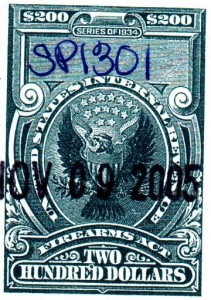 For an NFA collector it is truly a special day when an approved Form 4 and the accompanying tax stamp finally arrive. After all, you have waited long months for this day and suddenly it is here.
 For those of you who are not familiar with
  If you have tried to create an account or submit an application at